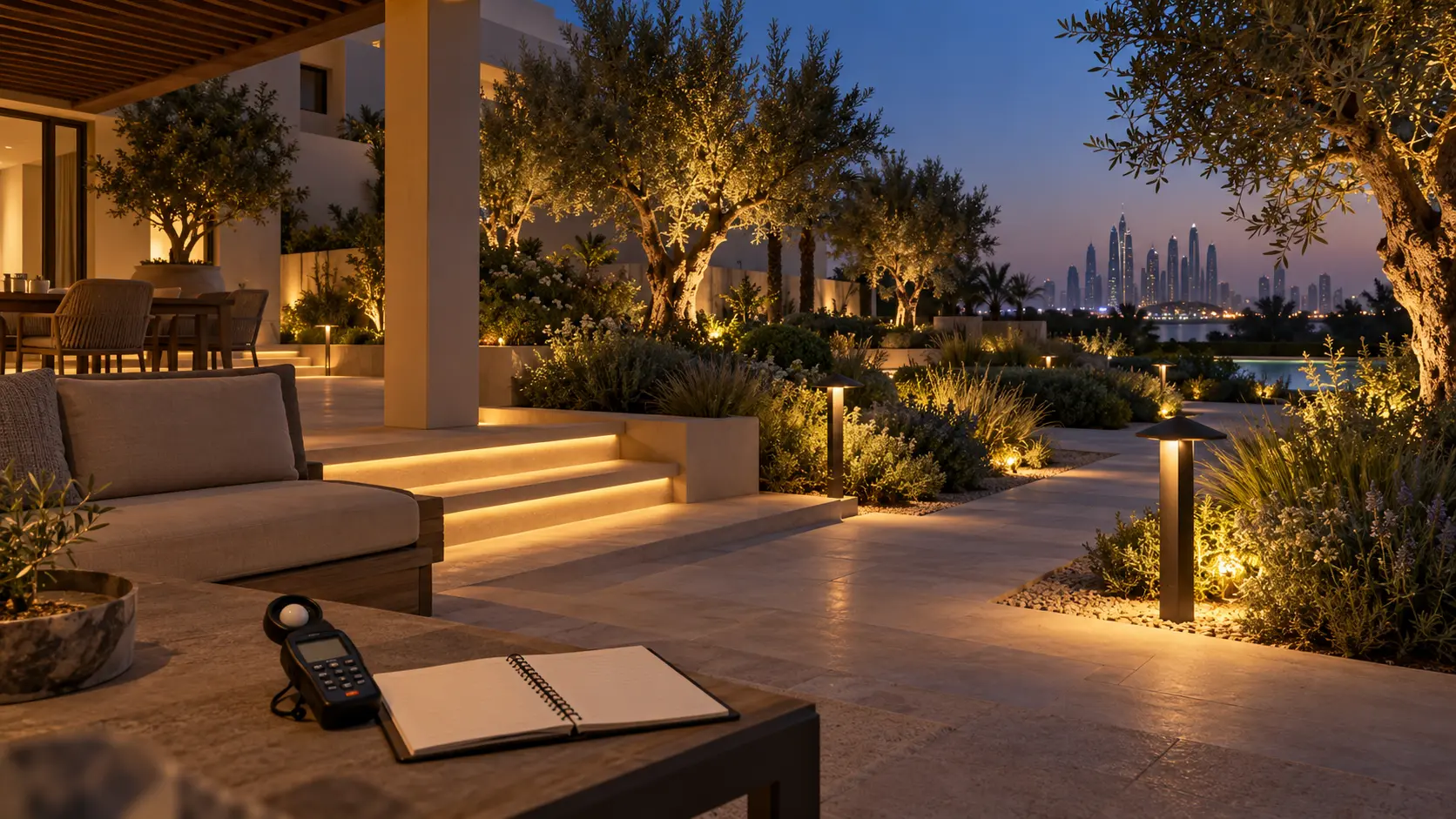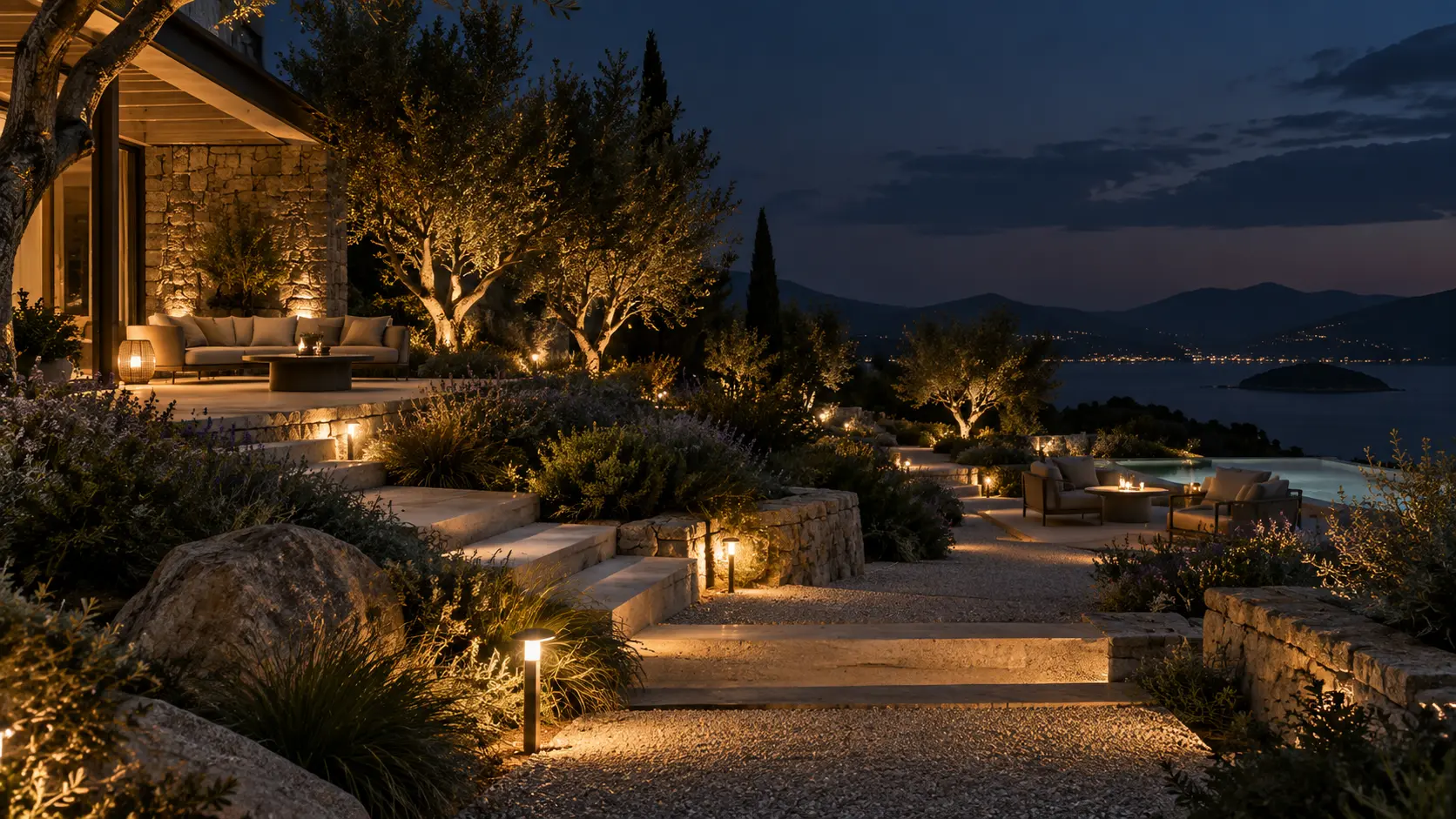
The direct answer
A useful outdoor-lighting brief begins by deciding what people must see and what should remain dark. Mark arrival and circulation routes, steps, occupied terraces, cooking or serving points, selected planting and boundaries that genuinely need attention. Give every luminaire a purpose, group uses into scenes and plan control and maintenance access. The result should support evening life without turning the garden into a uniformly bright room.
Begin with night-time activities
Walk through an ordinary evening on plan: arriving from the gate, crossing to the terrace, serving food, supervising the garden, sitting quietly and closing the house. Add occasional gatherings and maintenance tasks separately. This reveals where orientation, task light or a visible destination matters. It also prevents daytime focal points from automatically receiving a light when they add little to the evening experience.
Use a purpose test for every fitting
For each proposed light, write one function: guide, reveal a change in level, support a task, identify an entrance, model a selected plant or define an occupied edge. If the purpose is unclear or already met by another source, remove or combine it. DarkSky and the Illuminating Engineering Society frame responsible outdoor light as useful, targeted, low-level, controlled and warmer-coloured where possible. These are strong briefing principles, while the actual design still requires professional photometric and project review.
Control glare before adding brightness
A small visible source can feel harsher than a brighter surface that is evenly illuminated. Check likely views from seats, paths, neighbouring property and interior windows. Shield or position fittings so that people see the lit surface rather than the lamp where practical. Reflective paving, water and pale walls can change perceived brightness. A night-time aiming and commissioning visit is therefore part of the design process, not a cosmetic final adjustment.
Create scenes around time and use
Separate functional groups so the garden can respond to the occasion. An arrival scene may emphasise gates and paths; an entertaining scene can add terrace and selected planting; a late scene can reduce the garden to essential orientation or security needs. Controls should be understandable to the household, with manual override where appropriate. Avoid creating a complex interface that nobody uses. All electrical design, installation and testing outdoors must be completed by appropriately qualified professionals for the actual site.
Planning example
A villa garden concept includes path lights, six tree uplights, wall lights and a brightly lit pergola on one circuit. The evening review shows glare from the closest uplights and no way to keep the path on while reducing the terrace. The revised brief retains low-level route lighting, selects two trees as focal points, shields sources from seating views and divides arrival, terrace and planting into usable groups. This invented example demonstrates a decision process and does not specify electrical installation or light levels.
Coordinate light with planting and finishes
A lighting plan and a planting plan should not be developed independently. Note mature plant form, likely growth and maintenance access, then decide whether a light should reveal foliage, trunk texture or the space behind it. Pale walls and glossy leaves may return more light than dark textured surfaces. Paving joints and raised planters influence where fittings can sit without becoming trip or maintenance obstacles. Review fixture locations before irrigation and hardscape layouts are released, and protect tree roots and planting requirements through the detailed design.
Document the handover scene
At handover, label control groups in plain language and record the final aiming, dimming positions or schedules that were approved. Keep product references and access notes so a failed component is not replaced with a visibly different beam or colour without review. Photographing the intended scenes can support future recommissioning, but it should not replace measured checks where those are required. Agree who updates timers through seasonal use. A concise lighting asset schedule gives the household and maintenance team a better chance of preserving the original restraint.
Design for weather, growth and access
The selected fittings, connections and control equipment must suit the location and exposure, based on current manufacturer data and professional specification. Plant growth can block a beam or expose a source that was concealed at handover. Irrigation, soil movement and garden maintenance can affect positions. Record how fittings are reached, cleaned, re-aimed and replaced without damaging planting or paving. A beautiful initial scene that cannot be maintained is not a complete lighting plan.
Outdoor-lighting checklist
Review the checklist on plan and again on site after dark.
- Each fitting has one recorded purpose.
- Routes, level changes and task areas are prioritised.
- Views from seats, rooms and neighbouring edges are checked for glare.
- Arrival, entertaining, late and off states are defined.
- Controls are simple enough for the household to use.
- Fitting suitability and electrical details are professionally specified.
- Plant growth, irrigation and maintenance access are considered.
- A night-time aiming and commissioning review is included.
Limits and next step
Concept images cannot show real brightness, colour appearance, glare or spill. Planting will change over time, and manufacturer performance depends on the chosen optic, output, mounting and control. The next step is a coordinated night plan with purposes and circuit groups, followed by sample testing where uncertainty is high. Review final aiming after the garden and furniture are in place, then keep an asset and control schedule for maintenance.
Sources & further reading
Make this useful for your project.
A review of your property and priorities can turn general guidance into a defined brief.
Explore Outdoor lightingDiscuss your project